
Local SEO Statistics 2026: 105 Industry Benchmarks Plus 12 Data Points From 18 Years Running Local SEO Campaigns

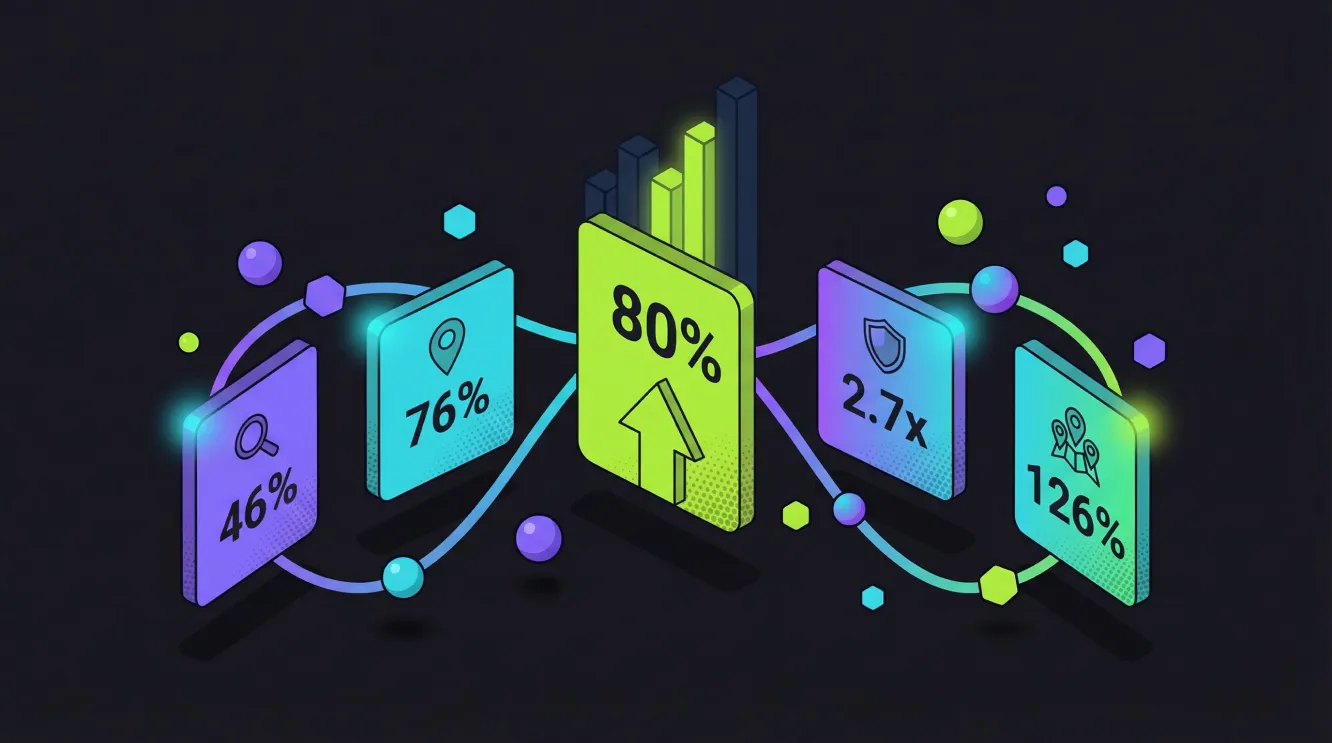
Local SEO is no longer optional for businesses that rely on nearby customers. With 46% of all Google searches carrying local intent and 80% of US consumers searching for local businesses online every week, your visibility in local search results directly affects your revenue.
Most local SEO statistics roundups aggregate the same BrightLocal, Backlinko and Semrush surveys without telling you which numbers actually move revenue. I have spent 18 years running local SEO campaigns that have generated more than $26 million in attributed client revenue across Google, AI Overviews, ChatGPT and other platforms, so this article does two things at once. First, the 12 first-party data points below come from our own client work. Second, the 105 industry benchmarks underneath are sourced, linked, dated and reconciled, so you can use them in a deck or proposal without inheriting somebody else's misattribution.
Where an industry stat clashes with what we see in our local SEO campaigns, I flag it. Where the published source is one to three years old, I say so rather than letting the date drift. The full set covers consumer search behaviour, Google Business Profile, Map Pack rankings, online reviews, AI search and industry adoption.
Turn Local SEO Statistics Into Measurable Revenue, Not Just Slide Decks
These statistics tell a clear story. Local search visibility drives measurable revenue, AI-referred visitors convert at materially higher rates than traditional organic, and most businesses still don't have a formal local SEO plan. Our local SEO services pair the industry benchmarks with our own operator data to turn local search visibility into consistent customer acquisition across Google, Google Maps, AI Overviews and AI platforms like ChatGPT and Perplexity.
Explore Local SEO ServicesRankmax Local SEO Data: 12 First-Party Operator Benchmarks
These statistics come from our own client engagements rather than third-party surveys. They are the numbers we use internally when planning a local SEO campaign or sizing the opportunity for a prospect.
These data points show what local SEO looks like when it is being run as a measured revenue channel. In our local SEO campaigns we treat these as the actionable signals because each one is tied to either a budget decision, a measurement decision or a risk-management decision we have to make for clients every month.
- 18 years operator experience running local SEO campaigns across legal services, B2B, B2C, eCommerce and SaaS verticals (source: Rankmax founder bio).
- $26M+ attributed client revenue from local search and AI search across Google, AI Overviews, ChatGPT and other platforms (source: Rankmax best-local-seo tool review).
- AI search traffic converted at 6.24% versus 3.29% for traditional organic search on a B2B local services engagement (source: Rankmax B2B AI SEO case study).
- AI-referred visitors converted 23x higher than organic search visitors on a single high-consideration engagement, making AI citation a measurable acquisition channel rather than a brand-awareness side-effect (source: Rankmax EEAT analysis).
- 598 AI cited pages achieved across Google AI Overviews, ChatGPT, Gemini and Perplexity for a single B2B client over 27 months and counting, while direct competitors held zero AI visibility for the same query set (source: Rankmax B2B AI SEO case study).
- 65 total AI citations including 54 Google AI Overview citations on a B2C local-services engagement over 11 months (source: Rankmax B2C AI SEO case study).
- About $8.7M attributed revenue generated from local and AI search on a single B2B engagement over 27 months and counting; the 17-month climb window attributed $5.9M at a 6,864% average ROI (source: Rankmax B2B AI SEO case study).
- $40-80 per month is the local SEO tooling budget that covers a single-location business when Google Business Profile is paired with one citation-management platform (source: Rankmax best-local-seo tool review).
- $100-300 per month is the realistic local SEO tooling budget for a multi-location business depending on location count, before agency fees (source: Rankmax best-local-seo tool review).
- $500+ per month is the local SEO tooling budget enterprise operations with 50 or more locations typically need, usually combining Yext with a separate reporting platform (source: Rankmax best-local-seo tool review).
- 20%+ of consumers default to Apple Maps because they use iOS, which means standard Google-only rank tracking misses a measurable slice of real local visibility, particularly for retail, hospitality and professional services in Australian capital cities (source: Rankmax best-local-seo tool review).
- Weeks of lost visibility is the typical real-world cost we have observed when a business stuffs keywords into the title field of its Google Business Profile and triggers manual reverification or profile lockout (source: Rankmax best-local-seo tool review).
General Local Search Behaviour Statistics
These statistics show how consumers search for local businesses and which platforms they use to find them. In our local SEO campaigns the most actionable signal in this set is the Google share, because it determines where 70% to 80% of optimisation budget should sit before any other platform is touched.
How Consumers Search for Local Businesses
- 46% of Google searches have local intent (SearchEngineRoundtable).
- 8 in 10 (80%) US consumers search for a local business online at least once a week (BrightLocal).
- 32% of American consumers look up information about local businesses online at least once or multiple times a day (BrightLocal).
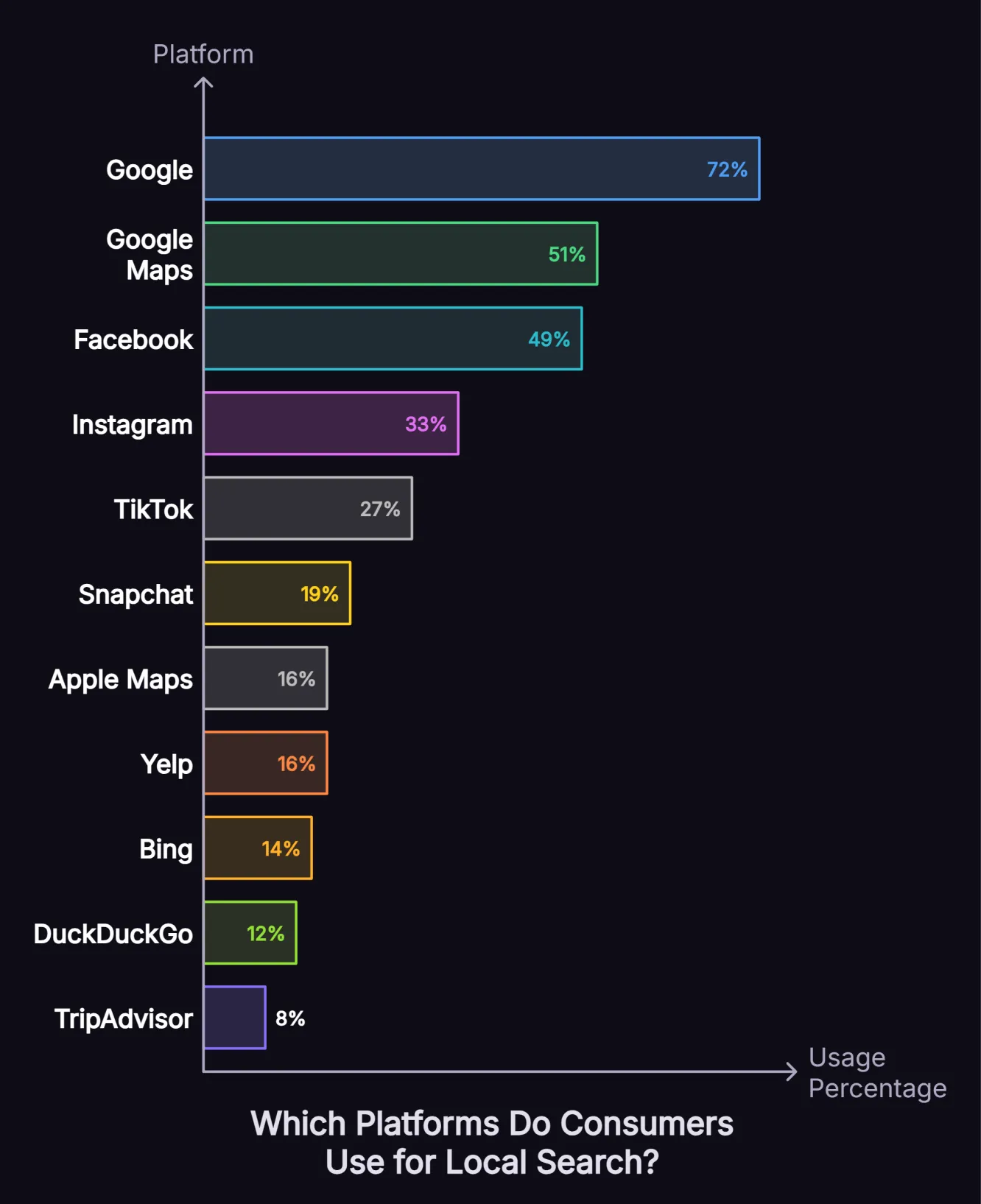
- 72% of consumers use Google to search for local business information (BrightLocal).
- 72% of consumers using Google for local business info drops to 61% for 18-24 year olds (BrightLocal).
- 51% of consumers use Google Maps for local search (Backlinko).
- 49% of consumers use Facebook for local search (Backlinko).
- 33% of consumers use Instagram for local search (Backlinko).
- 27% of consumers use TikTok for local search (Backlinko).
- 19% of consumers use Snapchat for local search (Backlinko).
- 16% of consumers use Apple Maps for local search (Backlinko).
- 16% of consumers use Yelp for local search (Backlinko).
- 14% of consumers use Bing for local search (Backlinko).
- 12% of consumers use DuckDuckGo for local search (Backlinko).
- 8% of consumers use TripAdvisor for local search (Backlinko).
How Younger Consumers Search Differently
- 67% of 18-24 year olds use Instagram for local business information (BrightLocal).
- 62% of 18-24 year olds use TikTok for local business information (BrightLocal).
Additional Local Search Behaviour Data
- 4 in 5 consumers use search engines to find information about local businesses (Think with Google).
- 96% of users learn about local businesses online (SEO.com).
- 61% of consumers use business information sites (Google, Yelp, TripAdvisor, BBB) to find information about a new local business (BrightLocal).
- 57% of local searches are performed using mobile devices (Semrush).
- Among all age groups, millennials are the most likely to perform local searches with the intention of visiting a business immediately (Semrush).
- Over 1.5 billion "near me" searches happen every month (SEO.com).
Local Search Actions and Conversions Statistics
These statistics show what consumers do after performing a local search and how quickly they take action. The most actionable signal here for our clients is the speed of conversion: when 76% of "near me" searchers visit within a day, the cost of being invisible during that 24-hour window compounds far faster than most businesses model into their forecasts.
- 76% of consumers who search for "near me" visit a business within a day (Think with Google).
- 88% of individuals who use a smartphone for a local search visit a related store within a week (Think with Google).
- Around 2 in 10 local searches on a smartphone led to a purchase within a day (Backlinko).
- 60% of mobile users have reached out to a business directly using the search results, for example "click to call" (Backlinko).
- Local mobile searches with a variant of "can I buy" or "to buy" have increased by 500% over the past 2 years (Backlinko).
- Worldwide searches on Google Maps for "shopping near me" have increased by more than 100% year over year (Backlinko).
- 80% of local searches result in conversions, where users convert into customers (SEO.com).
- 2 in 3 US consumers have already made a decision about what they're going to buy before they visit a physical store (BrightLocal).
- 40% of consumers visit Google when researching or planning a purchase they plan to make in a physical store (BrightLocal).
- 65% of US consumers approach holiday shopping with a mix of online and in-store spending (BrightLocal).
Consumer Trust and Business Information Accuracy Statistics
Incorrect business information online costs you customers. These statistics highlight why keeping your local listings accurate matters. In our local SEO campaigns the most actionable signal here is hours-of-operation accuracy. The 47% who walk to a competitor when your listed hours are wrong is the cleanest example of revenue leaked through avoidable data quality, and it is the cheapest fix on the local SEO punch list.
- 62% of consumers would avoid using a business if they found incorrect information online (BrightLocal).
- 56% of people find inaccurate information about a business online at least once every few months (Semrush).
- 47% of consumers would look for an alternative business nearby if the one they intended on visiting was closed (BrightLocal).
- 29% of consumers encountered businesses not stocking the products in-store that they said they did online at least once a month in 2023 (BrightLocal, 2023 data, two years old at audit date).
- 23% of people encounter fake business listings online at least once a month (Semrush).
- 40% of consumers have searched for a local business to see its opening hours at least a few times per month (Semrush).
- 39% of consumers search for local business information at least once a month to check if it's dog-friendly, child-friendly or accessible (Semrush).
Google Maps and Mapping Statistics
Google Maps is one of the most used platforms for finding local businesses. These statistics show how consumers use mapping tools and how they affect local visibility. The Apple Maps share is the one most operators underread. We treat 20%+ iOS Apple Maps usage as a planning baseline for any client with retail or hospitality footprint, because the gap between "we rank on Google Maps" and "we are visible to one in five iPhone users at the moment they are deciding" is exactly the kind of measurement blind spot that produces unexplained revenue gaps. For businesses looking to improve their mapping presence, an AI SEO strategy that covers Google Maps optimisation is a strong starting point.
- 88% of consumers use Google Maps, while 12% use Apple Maps (Backlinko).
- Among Apple users, 58.6% prefer to use Google Maps versus 26.3% for Apple Maps when searching for local businesses (Backlinko).
- 42% of people who conduct a local search click on results inside the Google Maps Pack (Backlinko).
- 70% of consumers use Google Maps to look for nearby businesses (SEO.com).
Google Business Profile (GBP) Statistics
Your Google Business Profile is often the first thing a potential customer sees. These statistics explain why keeping it complete and optimised directly affects whether people choose your business.
In our local SEO campaigns the most actionable signal here is review velocity, not the keyword-in-business-name correlation. The 38% stat below is the dangerous one in this section because it correlates keyword presence with top-three placement, but correlation is not causation, and Google now treats keyword-stuffing in the business name as a policy violation. Below the third-party numbers we add an explicit operator counter on this exact behaviour.
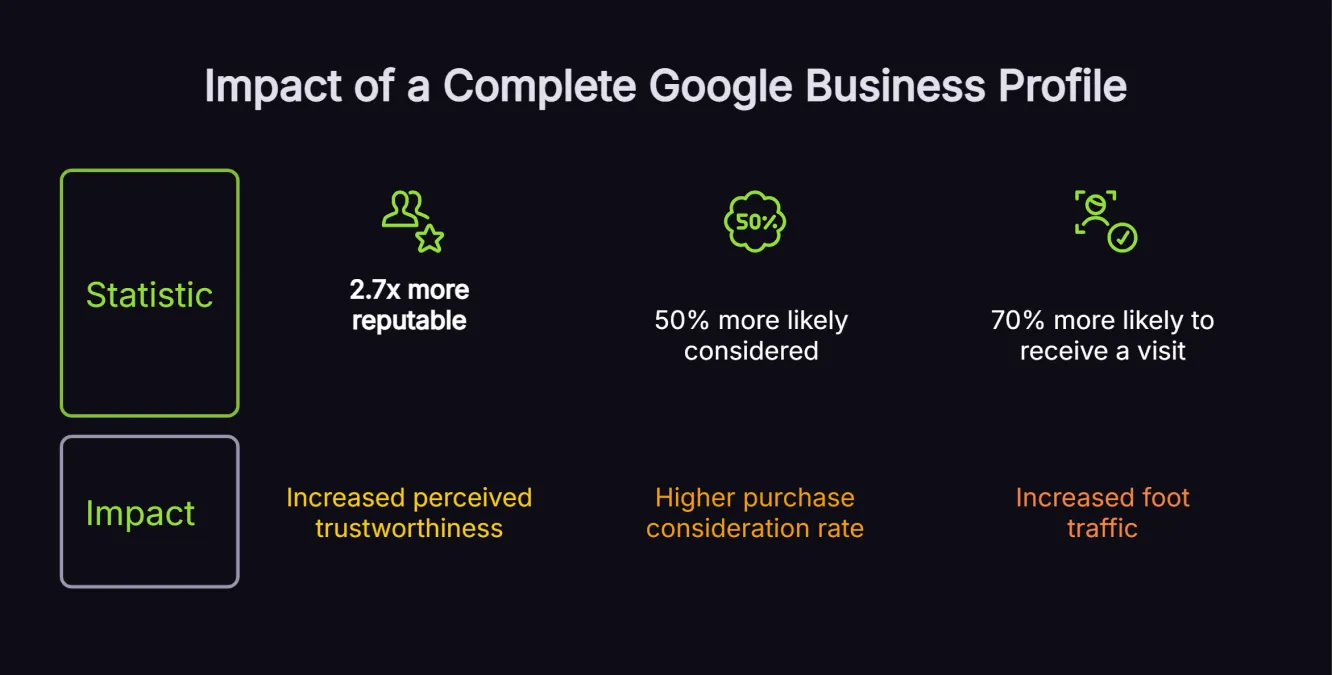
- Customers are 2.7x more likely to view a business as reputable if it has a complete Google Business Profile (Backlinko).
- Businesses with a complete Google Business Profile are 50% more likely to be considered for potential purchases (Backlinko).
- Customers are 70% more likely to visit a business with an optimised Google Business Profile (SEO.com).
- On average, a local business's Google Business Profile receives over 1,200 views monthly (SEO.com).
- Businesses in the top three spots in local search have an average of 561 Google reviews and an average review rating of 4.8 (Semrush).
- Businesses in the local map pack have an average of 993 backlinks and 216 referring domains (Semrush).
- 38% of businesses in the top 3 spots in local search include the target keyword in their business name on their GBP (Semrush). Rankmax operator warning: do not copy this tactic. Google has become extremely sensitive to keyword-stuffing in the GBP business title. Adding keywords to a business name that does not match your real-world signage commonly triggers manual video reverification, and if your name does not match exactly during that verification, the profile is locked and you lose the ability to make any further edits. We have seen businesses lose weeks of local visibility this way. The 38% correlation is descriptive of historical data; it is not a tactic to copy. Keep the business name clean and exact, and put optimisation effort into categories, descriptions, posts and reviews instead.
- Every 10 new reviews a business earns increases the conversion rate of its GBP by 2.8% (Semrush).
- For every 25% of reviews that a business responds to, the conversion rate of its GBP improves by 4.1% (Semrush).
- Calls, website clicks and direction requests from a GBP increase by 44% when a business improves its star rating by one star (Semrush).
- 54% of all Google reviews never receive a reply (Semrush).
Local Map Pack Rankings and Visibility Statistics
Getting into the Google Map Pack can dramatically increase your traffic and conversions. These local SEO statistics show what it takes to rank there and what happens when you do.
In our local SEO campaigns the most actionable signal here is geo-grid measurement at street level rather than postcode-level rank tracking. In dense urban environments such as the Sydney, Melbourne and Brisbane CBDs, you can rank well two streets over and be invisible at the exact intersection that determines foot traffic. Geo-grid heatmaps surface that block-by-block reality, and they are the measurement layer we use whenever a client's reported rankings do not match their reported foot traffic. Businesses that invest in content marketing optimised for local search are better positioned to earn these top spots.
- Businesses in the local map pack get 126% more traffic and 93% more calls, website clicks and direction requests compared to businesses ranked in spots 4-10 (Semrush).
- The most impactful ranking factors on Google's local pack include: primary GBP category, keywords in GBP title and proximity of address to the point of search (Backlinko).
- Google may use 149 ranking factors for local searches (Backlinko).
- The most significant local organic ranking factors are: dedicated page for each service, internal linking across the entire website and quality and authority of inbound links to the domain (Backlinko).
- For informational local-intent search terms, business directories account for 37% of organic search results (Backlinko).
Local SERP Composition Statistics
Understanding what types of results appear in local search helps you plan where to focus your optimisation effort.
- Local search queries show the following types of results in Google's first ten organic results:
- Business websites (47%)
- Directories (31%)
- Business mentions (16%)
- Forums and discussions (7%)
(Source: BrightLocal Business Listings Visibility Study, 2024, most recent available as of audit date)
Online Reviews: Finding and Comparing Statistics
Reviews are a major factor in local search. These statistics show how consumers find, read and compare reviews before choosing a local business. In our local SEO campaigns the most actionable signal in this section is multi-platform review presence, not review count on a single platform. The 74% who use at least two platforms is the operational benchmark we plan reputation work against.
- 83% of consumers use Google to find local business reviews (BrightLocal).
- 75% of consumers "always" or "regularly" read online reviews when researching local businesses (Backlinko).
- 74% of consumers use at least two review platforms in their business research (BrightLocal Local Consumer Review Survey, 2025).
- 34% of consumers use three or more review platforms (BrightLocal Local Consumer Review Survey, 2025).
- 31% of US consumers use Instagram to find local business reviews and 20% use TikTok as alternative review platforms (BrightLocal Local Consumer Review Survey, 2025).
- 76% of US consumers consume video content when looking for review information about local businesses (BrightLocal Local Consumer Review Survey, 2025).
- 48% of US consumers use local news outlets to find reviews of local businesses (Semrush).
- The top three factors that influence consumers' decisions in local search include photos, Google reviews and a business's position on the search results page (Semrush).
- The top five most trusted platforms for finding information about local businesses are:
- Google (66%)
- Google Maps (45%)
- Business website (36%)
- Facebook (32%)
- Yelp (32%)
(Source: Backlinko)
Online Reviews: Writing and Responding Statistics
Actively managing your review profile affects both rankings and conversions. These statistics show how consumers engage with the review process.
- 96% of people are open to writing a review for a business (Semrush).
- 61% of local businesses use review management software (Semrush).
Online Reviews: Ratings, Trust and Impact Statistics
Star ratings and review sentiment have a direct impact on whether consumers choose your business. These statistics quantify that impact. In our local SEO campaigns we treat the 71% three-star floor and the 78% four-star floor as the two trust thresholds that matter most. Below 3.0 stars, you are functionally invisible regardless of ranking; below 4.0, you have a measurable conversion drag on every other channel.
- 91% of consumers say that the local branch reviews of a multi-location brand impact their overall perceptions of big brands in some way (BrightLocal Local Consumer Review Survey, 2024, one year old at audit date).
- 71% of consumers would not consider using a business with an average review rating below three stars (BrightLocal Local Consumer Review Survey, 2024).
- 63% of consumers said seeing mostly negative written reviews would make them lose trust in a business (BrightLocal Local Business Discovery and Trust Report, 2023, two years old at audit date).
- 69% of consumers feel positive about using a business after reading reviews that detail positive experiences (BrightLocal Local Consumer Review Survey, 2024).
- 88% of consumers say they'd use a business that responds to both positive and negative reviews (BrightLocal Local Consumer Review Survey, 2024).
- Only 47% of consumers said they would consider using a business that doesn't respond to its reviews at all (BrightLocal Local Consumer Review Survey, 2024).
- 88% of consumers have avoided a business after seeing negative reviews about it (Semrush).
- 78% of people won't consider a business with a rating lower than 4 stars (Semrush).
AI in Local Search Statistics
AI is changing how consumers discover local businesses and how search engines present results. These statistics cover AI adoption among marketers, consumer attitudes towards AI search and the growing role of AI Overviews in local results.
In our local SEO campaigns we see the AI channel doing two things at once that the third-party numbers do not capture. AI-referred visitors converted 23x higher than organic search visitors on one high-consideration B2B engagement, and AI search traffic converted at 6.24% versus 3.29% for traditional organic on another. Whatever the share-of-search number for AI Overviews ends up being in your vertical, the conversion-rate delta on the visitors who do come through is an operator-level signal that does not show up in the BrightLocal awareness data.
A second operator note before the numbers: local citations are still valuable in the AI search era. Even no-follow local citations influence AI search visibility through local references and entity signals, so the citation work that built your traditional local rankings is the same work that grounds your AI-search presence today. For businesses wanting to stay ahead of these changes, understanding how AI search works is becoming a competitive advantage.
On AI Overview prevalence, the cleanest reading of the public data is a timeline rather than a single number. AI Overview share grew rapidly through 2025 as Google expanded coverage. Treat the 7.9% baseline as an early-2025 read and the 40% Local Falcon read as a May 2025 snapshot, not as competing claims.
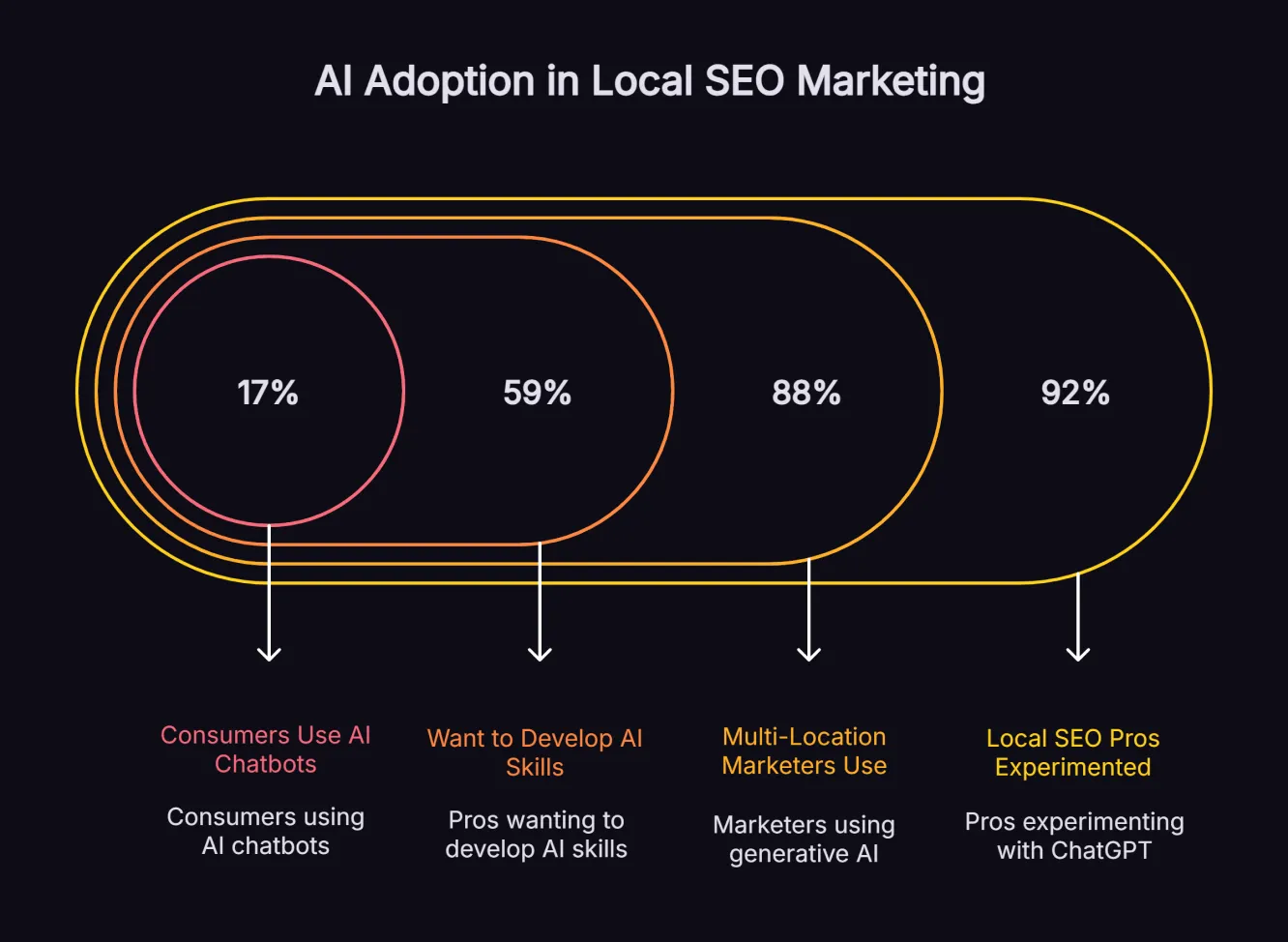
- 92% of local SEO and marketing professionals claim to have experimented with ChatGPT (Backlinko).
- Other commonly used AI tools by local SEO marketers include:
- Bard (41%)
- BingGPT (28%)
- Jasper (28%)
- Copy.ai (22%)
(Source: Backlinko)
- ChatGPT Search shows business websites for 58% of its local search sources, followed by business mentions (27%) and online directories (15%) (BrightLocal "Uncovering ChatGPT Search Sources," 2024, one year old at audit date).
- 88% of multi-location marketers are using generative AI within their organisations (BrightLocal Brand Beacon Report, 2024, one year old at audit date).
- 36% of high-performing brands are using AI to "a great extent" in their marketing, compared to 13% of average-performing brands (BrightLocal Brand Beacon Report, 2024).
- 59% of local agency marketers want to develop their AI and machine learning skills in 2025 (BrightLocal Local Marketing Industry Survey, 2024).
- 32% of US adults said they think AI would provide a better experience and outcome than typical search when looking for a local business (BrightLocal Brand Beacon Report, 2024).
- 61% of consumers feel well-informed about AI developments (BrightLocal Brand Beacon Report, 2024).
- 41% of consumers feel comfortable with businesses using AI to inform and communicate, so long as it improves their overall customer experience (BrightLocal Brand Beacon Report, 2024).
- 17% of US consumers are using AI chatbot technology like ChatGPT for search (BrightLocal Brand Beacon Report, 2024).
- 7.9% of local searches triggered an AI Overview earlier in 2025 (Search Engine Journal).
- 40% of local searches on Google displayed an AI Overview by May 2025 (Local Falcon). Read together with the previous stat, this is a timeline: AI Overview prevalence in local search grew from roughly 8% to roughly 40% across 2025.
- Prompts with a local intent trigger a web search in ChatGPT 59% of all instances (Position Digital).
Local SEO Industry and Strategy Adoption Statistics
These statistics reveal how businesses and marketers are approaching local SEO, and where the gaps are. The data shows that most businesses still lack a formal local SEO plan, which represents a significant opportunity.
In our local SEO campaigns we use a simple budgeting baseline alongside the adoption data: $40-80 per month for tooling at single-location, $100-300 per month at multi-location, and $500+ per month at 50+ locations where Yext-grade real-time sync starts to pay back. The 58% of businesses that don't optimise for local search are mostly in the first bracket and either don't realise tooling is available at that price or haven't ringfenced the spend. Conducting proper keyword research for local search is one of the first steps to closing that gap.
- 58% of businesses don't optimise for local search and only 30% have a local SEO plan in place (Semrush).
- 94% of high-performing brands have a dedicated local marketing strategy, compared to 60% of average-performing brands (BrightLocal).
- 56% of business owners manage local SEO for their business themselves; 25% have someone on their team do it (Semrush).
- 70% of local businesses have performed a local SEO site audit at some point (Semrush).
- 67% of local businesses have never performed a technical SEO audit (Semrush).
- 69% of local businesses use SEO tools or keyword tracking software to track how their business ranks for relevant local search terms (Semrush).
- 79% of marketers consider local SEO a highly effective strategy (SEO.com).
- 86% of local marketers say their clients are aware of how new developments in search could impact their business visibility and rankings (BrightLocal).
- Top-ranking pages on search engines have an average age of 2.6 years (SEO.com).
Local SEO Metrics and Services Statistics
These statistics show which metrics and services local SEO professionals and their clients consider most valuable.
- The top three local SEO metrics marketers see as important are:
- Rankings in the Google Local Pack/Local Finder (52%)
- New leads/enquiries (42%)
- Google organic rankings (41%)
(Source: Backlinko)
- According to marketers, the most valuable local SEO services are:
- GBP management (76%)
- Content creation (53%)
- Citation building/cleanup (43%)
(Source: Backlinko)
- According to clients (local businesses), the top 3 most valuable local SEO services are:
- GBP management (52%)
- Content creation (39%)
- Website design (34%)
(Source: Backlinko)
Frequently Asked Questions About Local SEO Statistics
What Percentage of Google Searches Have Local Intent?
46% of all Google searches have local intent, according to data shared by a Google official at Secrets of Local Search in 2018. This means nearly half of all Google search activity is from people looking for businesses, products or services near them. For businesses that depend on local customers, this makes local SEO one of the highest-ROI marketing channels available.
How Effective Is Local SEO for Driving Real-World Visits?
Local SEO is extremely effective at driving in-person visits. 76% of people who perform a "near me" search visit a related business within 24 hours, and 88% of smartphone users who conduct a local search visit a store within a week. This makes local search one of the strongest channels for converting online interest into offline revenue.
How Do Online Reviews Affect Local Search Rankings and Trust?
Online reviews directly affect both local search rankings and consumer trust. Businesses in the top three local search positions have an average of 561 Google reviews with a 4.8-star average rating. On the trust side, 71% of consumers would not consider using a business with an average rating below three stars and 88% of consumers say they'd use a business that responds to both positive and negative reviews.
What Is the Google Map Pack and Why Does It Matter for Local SEO?
The Google Map Pack (also called the Local Pack) is the group of three business listings that appears with a map at the top of Google's search results for local queries. It matters because businesses in the map pack receive 126% more traffic and 93% more actions (calls, website clicks and direction requests) compared to businesses ranked in positions 4-10. Getting into this top three is one of the most effective ways to increase local visibility.
How Is AI Changing Local Search in 2026?
AI is reshaping local search from multiple angles. AI Overview prevalence in local search grew from roughly 8% to roughly 40% across 2025 as Google expanded coverage. 92% of local SEO professionals have experimented with ChatGPT and 88% of multi-location marketers are already using generative AI. On the consumer side, 17% of US consumers are using AI chatbots like ChatGPT for search and 32% of US adults believe AI would provide a better experience than traditional search for finding local businesses. The signal that matters operationally is the conversion-rate delta on the visitors who do arrive through AI surfaces. In our own work, AI search traffic converted at 6.24% versus 3.29% for traditional organic on a B2B engagement, and AI-referred visitors converted 23x higher than organic search visitors on a high-consideration engagement. Businesses that optimise for both traditional search and AI search platforms will be best positioned for the future.
Do Most Businesses Have a Local SEO Strategy?
No. 58% of businesses don't optimise for local search and only 30% have a local SEO plan in place. This is a significant gap, especially considering that 94% of high-performing brands have a dedicated local marketing strategy compared to just 60% of average-performing brands.
How Important Is Google Business Profile for Local SEO?
Google Business Profile is one of the most impactful elements of local SEO. Customers are 2.7x more likely to view a business as reputable with a complete profile, businesses are 50% more likely to be considered for purchases with a complete GBP and customers are 70% more likely to visit a business with an optimised profile. GBP management is also rated as the most valuable local SEO service by both marketers (76%) and clients (52%). One operator note: do not stuff keywords into the GBP business name. Google enforces this aggressively and a profile that fails its manual reverification can be locked from any further edits, costing weeks of local visibility.
The Data Is Clear: Local SEO Drives Revenue
These 105 industry statistics paint a consistent picture, and the 12 first-party operator data points at the top of this article tie that picture to the actual budget, measurement and risk decisions a local SEO programme has to make every month. Consumers search locally, they act fast and they choose businesses that show up with complete profiles, strong reviews and optimised content. With AI search adding new dimensions to local discovery, and with our own engagements showing AI-referred visitors converting at 6.24% versus 3.29% for traditional organic, the businesses that invest in local SEO now will be the ones capturing the most revenue in the months and years ahead. If you're ready to turn local search visibility into a reliable growth channel, explore how our local SEO services can get you there.
About the Author
Want Insights Like This Fortnightly?

Our AI SEO strategies and tactics delivered fortnightly, including bonus trade secrets not shared anywhere else. No fluff. Just what's working right now. 5-minute read.


